TV Remote Control Universal
- 4.6
- Rating
- 100.00K
- Installs
- Free
- Price
 Analysis by App-foxy
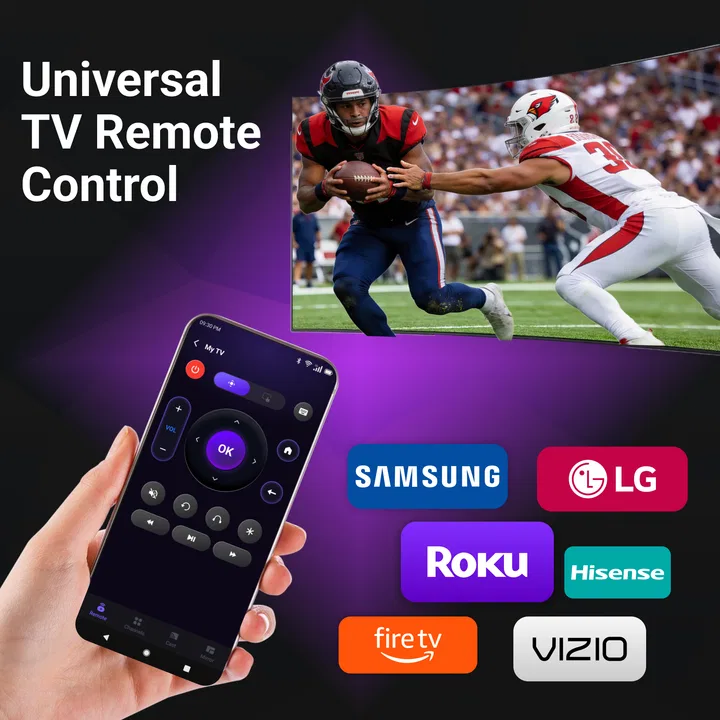
I tried TV Remote Control as a practical replacement for the collection of remotes that tends to gather around a living-room sofa. It is a free House & Home app from 8 square, built around controlling several familiar television platforms from a phone rather than searching for a missing handset. Its store summary covers Roku TV, LG, Samsung, Vizio, TCL and Fire TV, with casting for Roku also highlighted. That makes it more interesting than a simple single-brand remote, although the experience depends heavily on how well your television and phone work together.
The app has a 4.4 average from around 1,600 ratings, and it has passed 50,000 installs. Those figures suggest that it has found a real audience, but they do not remove the need to check whether your particular television is supported in the way you expect. I would describe it as a convenient backup and a useful everyday controller, not as an automatic replacement for every physical remote in every home.
How TV Remote Control fits into everyday use
I find a phone remote most useful when it solves a specific little interruption, not when I expect it to replace every controller in the house. In this section, I’m looking at how TV Remote Control fits into ordinary routines and how I’d test whether it’s dependable enough for yours. That practical starting point also makes it easier to weigh its free entry against the optional purchases.
You May Also Like

 Blood Strike: 2.5 Anniversary
Blood Strike’s Loadouts Turn Every Drop Into a Tactical Gamble
A close look at Blood Strike’s custom loadouts: how fast access to signature weapons reshapes its battle royale rhythm, rewards preparation, and narrows the gap between fights.

 Pandora - Music & Podcasts
Pandora’s Music Is Easy to Start, but Harder to Recover
Pandora’s strength is its low-effort path from a seed to a station. Its weak spot is how much confidence it asks you to place in connection, setup, and quiet recovery.

 8 Ball Pool
 Is Built on Rivalries, Rematches, and Routine
A close look at the rivalries, rematches, shared routines, and unanswered safety questions that turn a quick pool match into a persistent mobile community.

 Samsung Music
’s Quiet Strength Is Playing What You Already Own
Its reach comes less from spectacle than from dependable access to a personal library. That simplicity is both the app’s strongest retention engine and its ceiling.

 AccuWeather: Weather Radar
AccuWeather Review: A Quick, Clear Forecast for Everyday Decisions
For everyday plans, the best forecast is the one you can understand quickly. AccuWeather makes rain timing, radar, and local conditions easy to act on, with a few trade-offs.

 Hill Climb Racing
Why Hill Climb Racing Still Turns Crashes Into One More Run
A tiny car, a bumpy hill and one more upgrade: Hill Climb Racing keeps resurfacing because its simple chaos makes every near-miss feel personal.
More From Our News Desk
View All News


A free starting point with optional paid value
The important cost detail is straightforward: the app is free to install. That makes it easy to test before deciding whether it deserves a permanent place on your phone. In-app purchases range from $6.99 to $24.99 per item, so the free entry point and the paid value should be considered separately. I would not pay immediately simply because the app appears to support a certain brand. First, I would connect it, test the controls I use most, and decide whether the convenience is worth the purchase for my household.
This pricing structure is especially relevant for a remote app because the basic job is easy to judge quickly. If the television does not respond reliably, extra payment will not solve the main problem from a user's point of view. On the other hand, if the free experience handles daily commands smoothly and the paid option removes an annoyance you regularly face, the upgrade can be easier to justify. The sensible approach is to treat the free version as a compatibility check rather than assuming that every function has the same value on every device.
The app is rated for Everyone, which fits its purpose. I could imagine it being useful for a family member who struggles with a small physical remote, for a guest room where the original controller has disappeared, or for anyone who already keeps a phone nearby while watching television. It is also a reasonable emergency tool when batteries run out at an inconvenient moment.
What the app is trying to replace
Traditional remotes have one major advantage: they are always ready, familiar and independent of a phone battery. TV Remote Control takes the opposite approach. It puts the controller inside a device that is usually already in your hand, and it can reduce the number of physical remotes on the coffee table. That is useful when one television uses a brand-specific handset and another device uses a different one.
The advantage is not only fewer objects. A phone-based remote is easier to locate when the household has a habit of leaving the physical controller under cushions or in another room. It can also be more practical for someone who wants to adjust volume, pause a program or move through menus without getting up. In my view, the app makes the most sense as a dependable second remote, with the potential to become the main one if its connection remains stable.
It is less compelling for a person who already has a comfortable universal physical remote and never loses it. A physical controller also remains the better choice when several people need access at once, when nobody wants to hand over a phone, or when the television is used in a setting where phones are kept away. The app solves a specific inconvenience; it does not automatically improve every viewing setup.
Testing compatibility before relying on it
The first setup decision is choosing the television or platform that matches your home. Because the app is presented as universal across Roku TV, LG, Samsung, Vizio, TCL and Fire TV, it has a wider target than a remote designed for only one manufacturer. Still, “universal” should be treated as a starting point, not a promise that every model behaves identically. Television software, network arrangements and available controls can vary even within one brand.
I would test the connection in the same room where the television is normally used. Start with simple actions such as power, volume and navigation, then try the controls that matter to your routine. If you use Roku, I would also check the casting function separately rather than assuming that remote control and casting will feel identical. This small test prevents a common mistake: deciding that the app is unsuitable after one feature fails, or paying for it before discovering that the feature you actually need is limited on your setup.
A useful habit is to keep the original remote nearby during the first few sessions. That is not because the app is necessarily unreliable, but because it gives you a quick fallback while you learn its layout. It also helps identify whether a missing physical button is a real limitation or simply located somewhere less obvious in the phone interface. Once the important commands work, the phone can become a practical backup instead of a source of frustration.
Where the Roku focus matters
The store summary specifically calls out casting Roku, which gives Roku users an extra reason to investigate the app. Remote control and casting serve different moments. A remote is useful for changing channels, adjusting sound or moving through menus, while casting can be more convenient when you are already browsing content on the phone. Keeping those roles distinct makes the app easier to evaluate.
For a Roku household, I would judge the app on a complete routine rather than on a single successful connection. Try opening the television, navigating, returning to the home screen and switching between ordinary controls and casting. If you regularly discover content on your phone, casting may add genuine value. If you mostly watch through a set-top box or use the television's own apps, the casting element may matter much less than responsive basic buttons.
This is one of the less obvious trade-offs: a feature can be useful without being central to every user. Someone buying the app primarily for Roku casting should confirm that the workflow fits how they already choose content. Someone who only needs volume and navigation should not overvalue casting when comparing this app with a simpler remote utility.
A realistic living-room scenario
Imagine arriving home with the physical remote left in another room and your phone already in your hand. With TV Remote Control installed, you can try connecting to the television, adjust the volume and start watching without interrupting the evening to search for the handset. Later, if someone changes the volume while the remote remains on the sofa, the phone offers a second control point. That is a small convenience, but it is exactly the kind of repeated friction a remote app can remove.
Another scenario is a guest room. A spare television may be used only occasionally, and its remote can easily be misplaced between visits. A phone app can be quicker to reach for than buying another physical controller, provided the television is compatible and the phone can connect as expected. I would still leave the original remote available for visitors, because not everyone wants to learn a phone-based layout.
For families, the outcome is more mixed. Several people may appreciate having their own controller, but a phone is personal and may be locked, charging or being used for something else. In that situation, the app works best as a backup rather than a shared household standard. Its value comes from availability, not from replacing every other control method.
Small workflow choices that improve the experience
I would place the app somewhere easy to reach instead of burying it in a folder. A remote is most useful when it takes less time to open than it takes to find the physical one. It also helps to decide which phone in the household is the dependable backup. That phone should normally remain charged and connected to the same home environment used by the television.
When testing, check the commands in the order you actually use them. Many people care more about volume, pause, directional navigation and returning home than about rarely used settings. This gives a clearer picture of practical value than trying every control without a plan. If the core routine feels natural, the app is doing its job even if a secondary function is less convenient.
I would also avoid judging it after only one location test. A connection that works beside the television may behave differently from one attempted from another room. Trying the app from the sofa, the kitchen and the usual charging spot can reveal whether it is suitable as a whole-home solution or mainly a same-room controller. That distinction matters if you expect to operate the television while moving around the house.
Limitations I would take seriously
The biggest limitation is dependence on a compatible television setup. A broad brand list is helpful, but it does not guarantee the same behavior across every model. If your television is older, uses an unusual configuration or sits on a network arrangement that prevents communication, the app may not deliver the seamless replacement you hoped for.
A phone remote also depends on the phone itself. A low battery, a locked screen, a busy notification session or a phone being used by another person can make the controller less available than a physical handset. This is not a flaw unique to TV Remote Control, but it changes how I would use it: I would keep the physical remote for emergencies and treat the app as the convenient option when the phone is already close.
There is also a learning cost. Physical remotes use fixed buttons that can be found by touch; a phone interface may require looking at the screen. That can be less comfortable in a dark room, especially for someone who prefers tactile controls. People with accessibility needs should test the layout personally before deciding that a phone is easier than a large-button physical remote.
The paid range creates another trade-off. Since the app starts free, the upgrade should be judged against the exact benefit it provides in your routine, not against the existence of a universal label. If your television connects but the controls you need are already available without payment, spending more may not improve your experience enough. Conversely, someone who uses the app every day may reasonably see paid access as a convenience purchase rather than an unnecessary expense.
How it compares with the usual alternatives
A brand-specific remote app may be preferable when you own one television and want the deepest match with that manufacturer's controls. TV Remote Control is more appealing when the household uses different brands or when you want one general-purpose starting point. The trade-off is that a broader target can feel less tailored than an app built around one platform.
A universal physical remote remains stronger for shared use, tactile operation and independence from phone charging. It may also be easier for guests and older relatives who do not want a touchscreen involved in watching television. The phone app wins on convenience when the handset is missing and on the possibility of keeping several television controls in one device.
The television's own remote and operating system may still be the simplest option for people who rarely lose it. There is no setup to repeat and no need to keep another app available. I would choose TV Remote Control when the repeated problem is access to the remote, not when the existing setup already feels effortless.
Who gets the most value
I think the strongest audience is someone with a supported television who regularly misplaces the physical remote, wants a backup or manages more than one television brand. Roku owners should pay particular attention to the casting workflow, especially if they already browse content on a phone. The app can also suit a guest room, a temporary viewing area or a household where phones are consistently close at hand.
It is less suitable for someone who needs a completely tactile controller, wants a shared remote that anyone can pick up, or expects every television function to mirror a particular original handset. It is also not the first choice for a person who dislikes phone-based controls or cannot keep the phone available while watching. In those cases, a physical universal remote or the manufacturer's own controller is likely to be a better fit.
The current release is version 1.1.1, and the app requires Android 7.0 or later. That makes the Android requirement worth checking before planning to use an older phone as a dedicated remote. If the spare device falls below that requirement, the app cannot serve that role, even if the television itself is supported.
My final decision on the download
I would recommend trying TV Remote Control when you want a free way to test phone-based control across Roku TV, LG, Samsung, Vizio, TCL or Fire TV. Its strongest value is practical rather than flashy: it can give you a second route to the television when the original remote is missing, inconvenient or shared with someone else. Roku casting may add another useful workflow for the right household.
I would not treat the paid options as an automatic bargain. The free installation lowers the risk, so I would connect it, test the controls I use every day and only then decide whether any paid value is justified. That is the fairest way to assess it because compatibility and personal routine matter more here than a feature list.
My verdict is a cautious recommendation for Android users who want a flexible backup and have a supported television. It is a skip for anyone who already has a reliable physical remote, needs tactile buttons or expects a perfect one-to-one copy of a particular manufacturer's controller. For the right living room, the app earns its place by removing small, recurring remote-control frustrations, and its free starting point makes that judgment easy to make for yourself.
FAQs for TV Remote Control Universal
01How does the TV Remote Control Universal app work with different TV brands?
The TV Remote Control Universal app is designed to be compatible with a wide range of TV brands by utilizing your smartphone's infrared (IR) blaster. It supports major brands like Samsung, LG, Sony, and more. Some models may require additional setup via WiFi or Bluetooth, ensuring seamless integration and control over your TV.
02Is the TV Remote Control Universal app easy to set up?
Yes, setting up the TV Remote Control Universal app is typically straightforward. After downloading, the app guides you through a step-by-step process to pair your device with your television. Ensure your phone has an IR blaster, or use WiFi/Bluetooth if supported, to complete the setup efficiently and start controlling your TV.
03What features does the TV Remote Control Universal app offer?
The app comes packed with features to enhance your viewing experience. It includes standard remote functionalities like volume control, channel switching, and power on/off. Additionally, it may offer advanced features such as voice commands, customizable layouts, and smart TV integration, making it a versatile tool for any user.
04Is the TV Remote Control Universal app free to use?
The app is available for free download, providing basic functionalities at no cost. However, it may offer in-app purchases or a premium version that unlocks additional features, such as ad removal or enhanced control options. Check the app store listing for detailed information on pricing and features.
05What should I do if the TV Remote Control Universal app doesn't work with my TV?
If the app doesn't work with your TV, first ensure your smartphone has an IR blaster or that your TV supports WiFi/Bluetooth connections. Double-check the app settings and consult the help section or support team for troubleshooting tips. Compatibility may vary, so ensure your devices are supported.
Pros
- Supports multiple TV brands
- User-friendly interface
- Quick setup process
- Free to download
- Customizable remote layout
Cons
- Contains in-app ads
- Limited advanced features
- Requires stable Wi-Fi
- May not support older TVs
- Occasional connection drops

TV Remote Control Universal
Gallery